Exit Ban: How to Find Out the Reason and Lift the Restriction
Who This Is For and the Short Answer
Instructions for those whose departure from Russia has been restricted but who have received no notices or orders: it applies equally to Russian citizens and foreign nationals — debt-related restrictions are imposed through the Federal Bailiff Service (FSSP).
Short answer: check yourself in the FSSP enforcement proceedings database and on Gosuslugi, find the bailiff and the basis for the restriction, obtain the order, pay the debt using the payment details with the UIN, submit an application to cancel the restriction, and wait for the data exchange with the border service. Without a bailiff’s order, any “removal for money” is a scam.
When This Happens
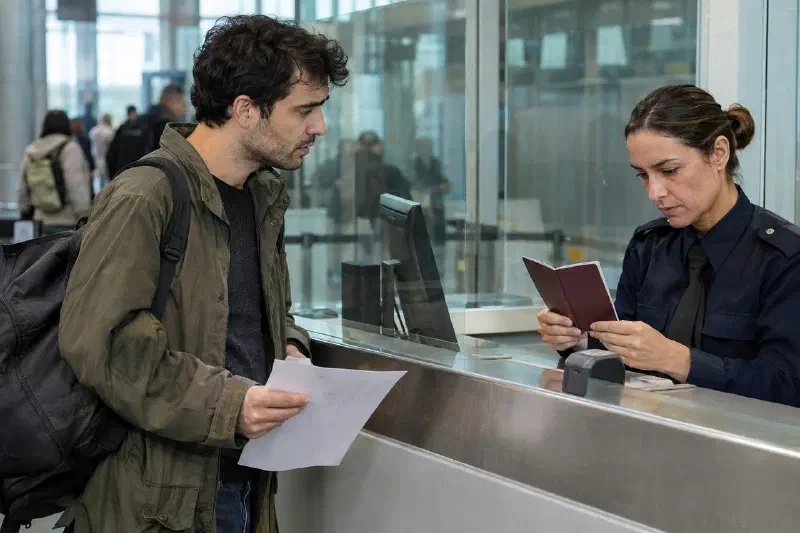
- You learn about the ban at the airport or border when departing.
- Your employer or airline informs you about the restriction before you do.
- The debt arose without your participation: a court order is issued without summoning the parties.
- Mistaken identity: your full name and date of birth match those of the actual debtor.
Step 1. Check Yourself: FSSP and Gosuslugi
Enforcement Proceedings Database
- Open the official “Enforcement Proceedings Database” service on the FSSP website.
- Search by individual: full name, date of birth, and region. For a foreign national — region of stay or registration.
- Review the proceeding number, amount, subject of enforcement (loan, alimony, fines, taxes), and the office with the enforcement bailiff’s phone number.
- Save a screenshot or PDF of the record with the date — this is evidence for a dispute or appeal.
Gosuslugi
A verified personal account provides access to the “Enforcement Proceedings Status” service and court-debt notifications. A foreign national with RuID and a verified account has access to the same service. If Gosuslugi and the FSSP database differ, rely on the bailiff’s order and request an official copy.
Step 2. Bailiff, Order, and Payment
Find the Bailiff and Request the Order
- Call the office listed in the proceeding record or schedule an appointment through the FSSP website / Gosuslugi.
- Submit an application for a copy of the order imposing a temporary departure restriction and a debt calculation. Through Gosuslugi, the application is recorded by date — creating your evidentiary trail.
- The order states: the basis (proceeding number and enforcement document), amount, date of restriction, and appeal procedure.
Pay the Debt Correctly
- Pay using the details in the order or proceeding record: incorrect KBK/OKTMO codes credit the payment to a different budget, and the debt formally remains outstanding.
- Keep the receipt with the UIN — it is used to match the payment to the proceeding automatically.
- Submit an application to the bailiff to attach the receipt and cancel the restriction through Gosuslugi or the office registry.
Step 3. Lifting the Restriction and Data-Exchange Timeframes
Cancellation of the restriction is a bailiff’s order that is sent to the FSB Border Service through interagency data exchange. In practice, data is updated within one to two business days, sometimes longer; no exact timeframe is guaranteed by regulation.
- Do not buy a non-refundable ticket for the payment date: allow at least 3–5 business days of buffer.
- Two days after the order is issued, ask the bailiff to confirm that the information was sent to the border service.
- Before departure, repeat the check in the FSSP database and verify the proceeding status on Gosuslugi.
Final Checklist Before Travel
- Checked the FSSP database by full name and date of birth in all regions of stay.
- Checked Gosuslugi: debts and proceeding status.
- Obtained the order and payment details from the bailiff.
- Paid using the UIN, saved the receipt, and submitted an application to cancel the restriction.
- Obtained confirmation that the data was sent to the border service.
- Allowed sufficient time before departure and repeated the check.
Documents and Action Table
| Document | Where to Obtain It | Why It Is Needed |
|---|---|---|
| FSSP proceeding record | Database on the FSSP website | Proceeding number, amount, bailiff’s office, and phone number |
| Order restricting departure | Bailiff / application through Gosuslugi | Basis, amount, and appeal procedure |
| Payment receipt with UIN | Bank / online bank | Proof of payment and payment matching |
| Application to cancel the restriction | Gosuslugi / office registry | Starts the process of lifting the restriction and exchanging data |
| Passport, TIN, SNILS | Personal documents | Identification in a mistaken-identity dispute or error |
| Situation | Action |
|---|---|
| Debt paid, but ban remains | Application to the bailiff with the receipt; request confirmation of data exchange with the border service |
| Someone else’s debt (mistaken identity) | Application regarding incorrect identification with copies of documents; complaint to the senior bailiff |
| Court order issued without your participation | Application to set aside the order, then reversal of enforcement and lifting of measures |
| Amount is incorrect | Request a debt calculation; complaint to the senior bailiff; if denied — administrative claim |
Risks, Mistakes, and Edge Cases
- Payment sent “to the wrong place.” Incorrect KBK/OKTMO codes mean the payment goes to another budget and the debt remains. Verify the regional payment details and submit an application to clarify the payment.
- Non-refundable ticket immediately after payment. Data exchange takes time; allow a buffer and repeat the check.
- “We will lift the ban within an hour without a bailiff.” Legally, only the bailiff can lift the restriction by issuing an order; intermediaries without an order create a risk of losing money.
- Someone else’s debt. A matching full name and date of birth requires an application for incorrect identification with your passport and TIN; a complaint to the senior bailiff is usually reviewed within ten days; if denied — file an administrative claim with a motion to suspend the measure.
- Debt threshold. A departure restriction under Article 67 of Federal Law No. 229-FZ applies to debts from RUB 30,000 (for alimony, compensation for harm to health, and harm resulting from the death of a breadwinner — from RUB 10,000), or for a smaller amount if the debt is not paid within the voluntary-compliance period after two months from the date enforcement proceedings are initiated. See the order and the law for the exact grounds.
Frequently Asked Questions
Why Did I Not Receive a Notice of the Ban?
Copies of the order are sent to the registration address in the enforcement-case materials, rather than the actual place of residence; for foreign nationals, letters often go to the receiving party or employer and are lost. A court order is issued without summoning the parties. The absence of a letter does not mean that there is no restriction — check the FSSP database yourself.
How Does a Departure Ban Differ From an Entry Ban?
Departure is restricted by bailiffs for debts and certain other grounds; it is lifted by payment and an order. Entry may be denied by the Ministry of Internal Affairs, the FSB, and other authorities for migration-rule violations, criminal convictions, and deportation decisions — this is a separate procedure: checking an entry ban and how to lift an entry ban. The controlled persons register concerns presence within the country: checking the register.
Can I Leave if the Debt Is Paid but the Data Has Not Yet Been Updated?
The risk of refusal at the border remains until the border service receives the cancellation order. Wait for confirmation of the data exchange and a repeat check; for urgent travel, request from the bailiff a copy of the order and confirmation that the information was sent, but the border service makes the decision at the border based on its own data.
Official Sources
- FSSP of Russia — enforcement proceedings database — check proceedings, amounts, and the bailiff’s office.
- Gosuslugi — enforcement proceedings status — check debts and submit applications to the bailiff.
- Federal Law No. 229-FZ “On Enforcement Proceedings,” Article 67 — grounds and thresholds for temporary departure restrictions.
- Federal Law No. 114-FZ on the Procedure for Leaving the Russian Federation and Entering the Russian Federation, Article 15 — general grounds for restricting the right to leave.
Checked: 17.11.2026. VisitRF — informational guide: the final decision and procedure depend on the authority, region, and current version of the documents; consult a lawyer in disputed situations. Describe your situation in the lawyer question form — the first question is free.